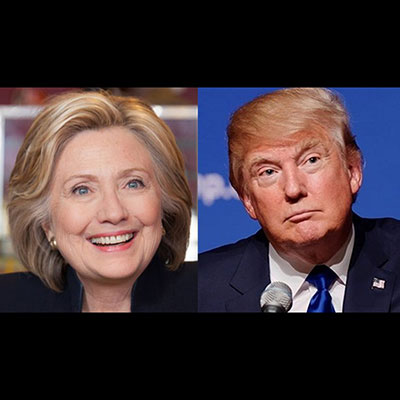
The 2016 United States presidential election in Pennsylvania took place on November 8, 2016, as part of the 2016 United States elections in which all 50 states and the District of Columbia participated. Pennsylvania voters chose electors to represent them in the Electoral College via a popular vote.
On April 26, 2016, in the presidential primaries, voters selected the Democratic, Republican, and Green parties' respective nominees for president. Pennsylvania is a closed primary state, meaning voters must have been previously registered with a particular political party in order to vote for one of that parties' candidates, to participate in their respective party primary.
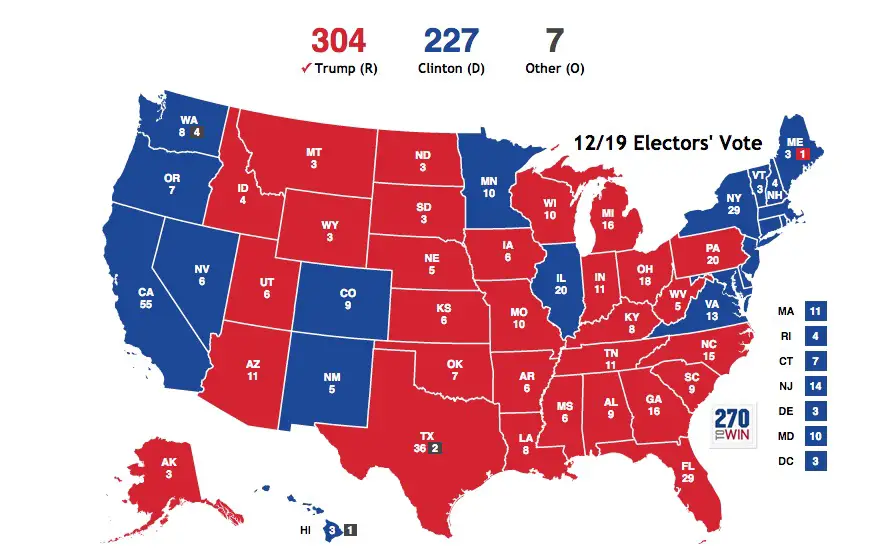
In the general election, Donald Trump, the Republican nominee, won Pennsylvania by 44,292 votes out of more than 6 million cast, a margin of 0.72% and the narrowest margin in a presidential election since 1840, when William Henry Harrison defeated Martin Van Buren by just 0.12%. Pennsylvania voted 2.82% more Republican than the nation-at-large, marking the first time since 1948 that it voted to the right of the nation.
Before the election, Pennsylvania was expected to be close as polling showed the results within the margin of error, but many election experts viewed that Clinton had an edge. However, on Election Day, Pennsylvania unexpectedly swung to Donald Trump. Trump carried 56 of the state's 67 counties, predominantly rural or suburban counties, while Clinton carried much of the Philadelphia metropolitan area as well as other cities including Pittsburgh, Harrisburg and Scranton. Nonetheless, some areas of traditional Democratic strength such as Luzerne County, where Wilkes-Barre is located, saw swings in margins of up to 25% toward Donald Trump. He was the first Republican nominee for president to win the state of Pennsylvania since George H. W. Bush in 1988.
Primaries
Democratic primary
Republican primary
Green Party
Pennsylvania held a series of caucuses throughout April, culminating with a meeting on April 30 in Harrisburg, Pennsylvania, where delegates were assigned.
Democratic National Convention
From July 25 to July 28, 2016, Philadelphia hosted the 2016 Democratic National Convention. It was held at the Wells Fargo Center with ancillary meetings at the Pennsylvania Convention Center. Former Secretary of State Hillary Clinton was chosen as the party's nominee for president by a 59.67% majority of delegates present at the convention roll call, winning the nomination, while runner-up rival Senator Bernie Sanders received 39.16% of votes from delegates. Clinton then became the first female candidate to be formally nominated by a major national party as a presidential candidate in the United States. Her running mate, Senator Tim Kaine, the junior United States senator from Virginia, was chosen by delegates as the party's nominee for vice president by acclamation.
General election
Predictions
Results
By county
- Counties that flipped from Democratic to Republican
- Erie (largest city: Erie)
- Luzerne (largest city: Wilkes-Barre)
- Northampton (largest city: Bethlehem)
- Counties that flipped from Republican to Democratic
- Chester (largest borough: West Chester)
By congressional district
Trump won 12 of 18 congressional districts, including one which elected a Democrat, while Clinton won six, including two that elected a Republican.
Analysis
2016 was the first presidential election since 1948 in which the Democratic nominee won the popular vote without the state. Pennsylvania's vote for Donald Trump, along with that of Wisconsin and Michigan, marked the fall of the Democratic Blue Wall, a bloc of over 240 electoral votes that voted solidly Democratic from 1992 to 2012. Pennsylvania was one of the eleven states to have voted twice for Bill Clinton in 1992 and 1996 which Hillary Clinton lost in 2016. Although Wisconsin eventually delivered the Trump victory, when the Clinton campaign learned that they had lost Pennsylvania, they knew that they had lost the election. While political analysts generally agree that Clinton met her turnout targets for Democratic voters, especially among the key counties of Bucks and Montgomery, Republican voter turnout was unexpectedly high in 2016, leading to a Trump win regardless of the Clinton campaign hitting their targets. Trump became the first Republican ever to win the White House without carrying Chester or Dauphin Counties, as well as the first to do so without carrying Centre County since Benjamin Harrison in 1888, and the first to do so without carrying Monroe County since Calvin Coolidge in 1924. He also became the first Republican to win Pennsylvania without carrying any of Philadelphia's suburban counties. Trump was the first Republican nominee for president to win the Luzerne and Northampton counties since 1988. He was the first Republican to win Erie County since 1984.
See also
- List of United States presidential elections in Pennsylvania
- 2016 Democratic Party presidential debates and forums
- 2016 Democratic Party presidential primaries
- 2016 Republican Party presidential debates and forums
- 2016 Republican Party presidential primaries
References
Further reading
- David Weigel; Lauren Tierney (September 6, 2020), "The seven political states of Pennsylvania", Washingtonpost.com
External links
- RNC 2016 Republican Nominating Process Archived 2016-11-08 at the Wayback Machine
- Green papers for 2016 primaries, caucuses, and conventions